“Our aim in education is to give a full life. We owe it to them to initiate an immense number of interests. Life should be all living, and not merely a tedious passing of time; not all doing or all feeling or all thinking – the strain would be too great – but, all living; that is to say, we should be in touch wherever we go, whatever we hear, whatever we see, with some manner of vital interest. “Charlotte Mason
Today’s homeschool chat brings you Shannen (@middlewaymom) ,who is a long time homeschooler to her four daughters aged 20, 9, 6 and 4. She currently follows the Charlotte Mason method for her homeschool, enjoying the outdoors when the Minnesota weather permits, and aiming to make their homeschool a joy for everyone involved. Some days are more successful than others. Shannen is also a student of sacred knowledge and a volunteer in her local community, speaking at local interfaith community events and volunteering at the Islamic Studies class in the state women’s prison. When she’s at home she enjoys knitting, reading, and avoiding housework. You can find her mostly on Instagram at @middlewaymom sharing in her stories of everyday life as a homeschooler, and you can find articles on her blog, www.middlewaymom.com about an array of topics and curriculum she’s tried over the years.
1)Tell us a bit about your family and your child/ children.
Alhamdulilah, I’ve been married to a fellow convert for nearly 11 years now and I’ve been blessed with four daughters: 20, 9, 6, and 4 years old.
2)What was your main reason for choosing to home educate your children ?
As we have homeschooled for over 10 years now, the reasons have changed quite a bit. It first started as I didn’t think the school system was challenging my daughter enough academically for what she was capable of. Additionally, as I was a new convert to Islam, I had concerns about the social aspect of school and I didn’t feel like I was well equipped to manage that on the evenings and weekends only. I started homeschooling my younger daughters as I felt that I could give them a more well rounded, tailored education if we did it at home.
3)What does a “typical” home school day look like for your family ?
Again, this has changed a LOT over time, but currently I wake up around 6am and work on my own studies and get things done that are hard to do when the kids awake. I wake up the kids around 8am so they can have breakfast, do their morning chores, and be ready for their lessons at 9:15, in sha Allah. As of this year, we’ve added in a social studies class (I teach it) and Quran class at a local Islamic private school, so we have to finish lessons by 11:30 so we can have lunch, do chores, and be ready to leave at 12:30, in sha Allah. We return home about 4pm and go right into our dinner prep routine.
4)What type of a home educator are you ( structured , semi structured , unschooling , classical , Charlotte Mason , Steiner , Montessori etc ) ?
I try to follow the Charlotte Mason method quite closely as I have seen great benefit to our homeschool atmosphere when we do so. As a Muslim it takes a little extra work to get materials that fulfill the goals of the Charlotte Mason method, and are not Christian, but when I have put in that work, I enjoy the great fruits of those efforts, mashaAllah.
5)What do you love the most about home schooling ?
What I absolutely love about home schooling and why I hold on to it even when it is extremely hard and I think I’m not doing a great job at it, is I love learning with my kids and I truly believe that my love of learning is a gift to them to see that learning does not end when you graduate. I joke sometimes that the one good thing I’ve done as a parent is instill the love of books in all my kids (I know I’ve done more than that, mashaAllah). It is just a part of our culture at home, and with homeschooling, we get to dig into books together and discuss them. A really close second to what I love about homeschooling, though I do think it is connected, is being able to take my kids to museums and plays numerous times each year. Again, we get to learn and explore together and it is just such a joy.
6)What is your favourite subject to teach and what is your least one ?
It’s really hard to find a favorite… history comes to mind, but frankly, it’s very hard for me to find books that I really like that are honest about history yet child-friendly. Literature is another favorite just because it’s quite easy and it’s like we’re just sitting with a good book. If I’m being honest about my least favorite, it would in general be Islamic studies since I get anxious that I’m not doing enough. I have come to terms with the fact that my kids may have gaps in math or history, but if they grow up and they don’t have a proper understanding of Islam, I’d have a hard time dealing with that. Since I feel that pressure, that translates to pressure on my kids. So, what I’ve done is make sure I am not the only outlet they have to Islam, and they see Islam throughout the community and learn from people other than me, in addition to the lessons we have at home. Since I’ve been able to do that and I feel less pressure for every lesson to go *just right*, it’s been a lot more enjoyable, alhamdulilah.
7)What do you find challenging when it comes to home schooling your children
Patience is a challenge for me, and getting overwhelmed with 3 kids close in age. Of my four kids, not one of them would tell you that I’m a patient person. Still, it’s something I’m working on and I think that the value of homeschooling my kids is greater than my own personal shortcomings.
8)How do you deal with unsupportive family , relatives and friends ?
Alhamdulilah, our families have generally been supportive, or at the worst, neutral, about our decision to homeschool. It helps that my husband was homeschooled, so his family was obviously supportive, and my family got to see a “normal” adult that was homeschooled as a child.
9)Where do you see your home schooling journey in 5 years time ?
I guess I see myself just keep on keepin’ on with homeschooling. In 5 years I’ll have kids in 8th, 6th, and 4th grades, so what I picture is a lot of round table discussions, but what I’ve learned is that you just have to stay flexible, so it could look much different than that. In sha Allah I hope to continue supporting new homeschoolers in their journey, though, and I hope once I’m done with my own studies (should be done in 5 years, in sha Allah), and when the kids are older, I can start giving back a bit more.
10)What advice would you give to anyone who wants to start home educating their children ?
Homeschooling is not about memorizing facts. It is not about giving kids information and they keep that information in their brains forever. As Charlotte Mason says, “Education is an atmosphere, a discipline, a life.” RELAX if they don’t remember everything. Neither did we. Keeping their love of learning alive will bridge any educational gaps they are sure to have when they move on from you.
Make a plan, but stay flexible, and lower your expectations of your first year. That first year everyone is just getting used to being home, yet having expectations set upon them. Have that plan, but don’t freak out if things fall apart. Your first plan you’re making blindly, so be forgiving of yourself! PLAN PLENTY OF DAYS OFF. If you feel like you’re getting close to burn out, take another day off.
Everyone wants to quit in February. For real – everyone, even me, every year. Also, don’t spend too much money on curriculum until you know what really works with your family. Buy used or borrow when you can. Last, but not least, find what homeschooling method sounds best for you and use that as a guide for narrowing down resources. Your homeschool method is not a religion, you can take a little from here and a little from there, but it’s useful to narrow down what you’re looking at initially.
This year I managed to read quite a few books related to homeschooling . I found a lot of them extremely beneficial , helpful and life changing too and I thought that it would only be fair if I shared them with you all. Because sharing is caring 🙂 So below you will find my favourite homeschool books for 2019. Please note that this post includes affiliated links.
A Gracious Space by Julie Bogart– If there is one book that every single homeschooling parent should have in my opinion is honestly this one. What a treasure! I wish I discovered these books earlier. Julie Bogart is the owner and creator of Brave Writer, an innovative company that teaches writing and language arts to homeschooling families. “Since its inception in January 2000, Julie has taught thousands of homeschool families not only how to write, but how to create rich homeschool lives—the sort that we all imagine we’ll have but often fall short of living. Julie is a popular speaker at conventions in both the United States and Canada. She’s written curricula and online writing courses for grades PreK – 12th grade, and adjuncts as a professor of theology at Xavier University. She home educated her five children for 17 years, all of whom are adults now. Julie lives in Cincinnati, Ohio. ” A Gracious Space has three editions – Fall , Winter and Summer. It is basically a collection of thoughts and reflections on home education, drawn from Julie’s personal experience and the lives of thousands of Brave Writer families .
This particular edition provides ” daily readings that offer insights into the home education experience, as well as supplies encouragement, inspiration, and companionship on the journey. The entries are honest reflections drawn from Julie’s life and her interaction with the thousands of homeschoolers that are members of the Brave Writer community. Each entry is accompanied by a “quote of the day” written by a parent like you, or a notable individual. The day’s entry is concluded with a “sustaining thought” to take with you. “
I just finished The Fall edition, which I thoroughly enjoyed and I am now embarking on the Winter one. What I love about this book, is that it is not aimed at a specific curriculum strategy nor a singular homeschool philosophy. It doesn’t matter what type of a home educator you are , whether you are religious or not, any homeschooling parent will resonate with the daily reflections. The book can be bought from Amazon-https://amzn.to/2LOLVUJ
2) Give Your child the World – Raising Globally Minded Kids one book at a time by Jamie Martin – “Jamie Martin is a highly sensitive, introverted mama of three, who loves books, tea, and people (not always in that order) and avoids answering the phone when possible. Author of Give Your Child the World, she shares thoughts on parenting and personality over at http://www.introvertedmoms.com. ” She lives with her family in Connecticut.
What a Gem of a book this is ! This is truly more than a book- you do not read it just once and put it back on your bookshelf. It is a super inspirational guide book that contains over 600 children’s book recommendations from all around the world. The Book is separated in two parts: Part 1 : Falling in love with the world and Part 2: Read the World. I really enjoyed Chapter 2 ( part 1 of the book) which looked at practical ways to invite the world into your home, whether that’s home decor, food tasting or ethical spending. Part 2 includes the reading lists ( fiction and non-fiction, which are carefully curated. What I love about these reading lists is that they are organised not only by region ( Asia , Europe etc) and country, but also by age range too . There are three age ranges 4-6, 6-8, and 10-12. Each listing includes a brief description of the book and its themes, as well as any content of which parents should be aware . I cannot imagine the amount of time and careful research that Jamie must have done for her to produce such a fantastic and diverse list of incredible books. We were recently looking at the continent of Africa and it was so easy to find relevant books and it saved me so much time, as the reading lists were already in the book and I was able to find the relevant books for all my children. I was also pleasantly surprised that a lot of her books , I was able to borrow from my local library, which meant that I spent less money on purchasing books. I also loved the ” Global Perspective ” sections which are spread throughout the book. In this section, parents from all over the world,give their answers to the question “How do you give your children the world in your home?. “
This is truly one fantastic resource, that every family should own ( homeschooling or not) if you want to expose and broaden your children’s minds to some first rate literature from around the world. The book can be bought from Amazon –https://amzn.to/36yJjCD
3)The Read Aloud Family – Making meaningful and lasting connections with your kids by SarahMackenzie
“Sarah Mackenzie is an author, speaker, and podcast host. She created the Read-Aloud Revival podcast in 2014. That fateful decision resulted in a highly rated show with millions of downloads. Sarah helps families all over the world fall in love with books. She lives in the Northwest with her husband, Andrew. She homeschools their six kids and considers it her high calling to make sure they are well-stocked in the best books she can find. ”
” “When read-aloud time doesn’t look like we originally hoped, we begin to doubt that it’s giving us any of those wonderful benefits we discussed in part 1. But here’s the thing: it still works. Even when it’s noisy, messy, and more chaotic than you’d like it to be, it works. Even when kids are grumbling, complaining, and don’t seem to be listening, it works.”
To say that I enjoyed reading the ” The Read Aloud Family” By Sarah Mackenzie will be for sure an understatement. I absolutely loved and have been using it ever since I discovered it a few months ago. The Book is divided in three chapters:
Part 1 ” Time is now ” looks at how reading aloud can change the your world, tips on how to be fully present , as well as some of the many benefits of reading aloud to your children ( increased vocabulary and highly sophisticated language patterns, the ability to make connections and last but certainly not least , the love for learning ).
Part 2 is ” Connecting with our kids through Books”. I really loved this section, as it is full of tips and advice on topics such as how to create a book club culture at home, how to become a literary matchmaker , how to ask compelling questions and much more.
In Part 3 ” Meeting them where they rise “- Sarah gives the relevant read-alouds lists , split into a specific age group 0-3, 4-7, 8-12 and the Teen years. In this section, you will also be able to learn how to choose books for your children and what the most important aspect of this are.
This book will truly enable you to discover practical strategies to make reading a meaningful family ritual. Although the book is written by a homeschooling mum, the book will be great to anyone whether you home educate or not. “The Read Aloud Family can be bought from Amazon –https://amzn.to/34lBVcl
4)Better Together by Pam Barnhill
“Better Together teaches you how to design a part of your homeschool day where the entire family can learn together. This time, known as “Morning Time,” has exploded in popularity since its inclusion in Sarah Mackenzie’s bestseller Teaching From Rest. Now homeschool mom and former teacher Pam Barnhill breaks down the practice for every homeschooler. “
Pam Barnhill is a mom and former secondary teacher. When she’s not homeschooling her three kids, she can be found helping and encouraging homeschool moms at pambarnhill.com. She is the host of Your Morning Basket, a podcast devoted to helping families contemplate truth, goodness, and beauty in Morning Time, and The Homeschool Snapshots Podcast where she interviews homeschooling parents, providing a peek into their days. She lives with her husband, children, and a passel of dogs in beautiful Alabama.
I first heard about Morning time nearly 9 years ago , when i used to follow the blogs of a few American homeschool mums. Then when my eldest was 2 , I used to attend for a short period of time a Steiner parent adn toddler group once a week and we used to do a similar ritual , called Circle Time.
Morning time has always been part of our routine, although it has always looked different and needless to say changing depending on what stage of life we were/are at. So when I first discovered from Sarah Mackenzie that there is actually a book on morning time, I knew I had to read it. I loved reading it and it has given me even more well needed encouragement to persist with morning Time and also more ideas on what to include in our MT Basket. If you happen to be a morning time veteran, there is a lot of refreshment to be found in this book for you, too! I made a few really great tweaks to our schedule that have made a world of difference for us. I have included below ten tips ( my summary) that hopefully will give you an idea about what to expect from the book in regards to Morning Time:
Anyone can benefit from morning time- no matter what type of a home educator you are and what method or religion you follow.
USE MT to teach subjects such as science and history/geography to multi age children at one time
Find engaging material to read together
Quality over quantity- whether it is 10 minutes or one hour- it all counts
Use MT to introduce art and poetrt, never to Maths
There is no right or wrong anwer to how mcuh you read during MT
Your children do not need to sit still and be quiet
Morning Time does not have to be done on the table or even in the morning for that matter. Do it at a time and a place that works for you and your family.
Pam has also included snapshots/interviews of how other homeschooling families do Morning Time. I found them really very helpful and insightful. The book also contains lots of recommendations on what to include in your MT basket. The appendices at the end of the book had invaluable resources, many great ideas for MT areas of study. The book is written from a Christian viewpoint, so if you are a secular homeschooler, you may find the religious aspect a bit too much. The book can be bought from Amazon -https://amzn.to/38ANejS
5)How to Survive Homeschooling ( A self care guide for moms who lovingly do way too much ) By Brooke Benoit
“All mothers struggle to achieve balance in their lives, so how can homeschooling moms do it when they have taken on an entire other role? How to Survive Homeschooling: A Self-Care Guide for Moms Who Lovingly Do Way Too Much is the companion homeschool moms need to avoid burnout and to find their personal wellbeing. In this enjoyable and interactive book you will learn how to: Identify and take care of all of your various physical and emotional needs as an excruciatingly busy individual Track your progress as a homeschooler, a role model, and wholly-living person Further your personal goals aside from homeschooling your children Guard yourself and your family from interlopers Recognize how a homeschooling lifestyle is different and live it unapologetically Brooke also shares her unique story of homeschooling herself and then her children. “
” Brooke Benoit is a magazine editor and artist who attended the San Francisco Art Institute and earned a degree in Rhetoric from the University of Alaska Anchorage. After homeschooling herself for high school she began college at fifteen years old. When it came time to enroll her children in school, instead Brooke immersed herself in learning the various styles and means to homeschool. She has continued to work, returned to school and moved abroad while homeschooling. Brooke currently facilitates her seven children’s education (at home) on the southern coast of Morocco where she also enjoys photography, travel and lively chit-chat. ” She also runs Amsmoon, a third space, near her home where she helps other young people explore their interests and new things . Brooke is also the editor of “Fitra Journal” – four collections of wisdom from Muslim homeschoolers around the world. I cannot recommend this enough- they are so insightful and full of wisdom and advice. Once or twice a year Brooke very happily runs retreats for Muslim women in Morocco and London. Here are the details, if you would like to attend them. http://amsmoon.com/ Amsmoon – Collective Makers Aourir is a working-class, fishermen’s community just outside the economically strong and tourist-friendly city of Agadir. The majority of residents live below the poverty line, so how are they supposed to access the kinds of services proven to boost lives? amsmoon.com
If there is one thing that I can defintely say about this gem, is that I wished Brooke wrote this book 10 years ago when I first started became interested in homeschooling. There are hundreds of books on the varioys tyoes and methods of homeschooling, but not many about self care, about you as a person , and not losing yourself in the chaos that comes with being a homeschooling parent.
The book consists of two parts. The first part is a guided self care manual with short essays and lots of prompts with space for you to write your own answers and thoughts. I absolutely loved this section and enjoyed Brooke’s insights. This section will give you tips on how to identify and take care of all your various physical and emotinal needs, as well as how to track your progress as a home schooler, a role model and wholly living person.
Part 2 is a short autobiography of the author with a focus in her family, homeschooling and travel/living situation. I really enjoyed reading that memoir . Brooke truly is one inspirational woman and I honestly wish she wrote a book on her life in Morrocco while homeschooling her children.
The book is full of tips and advice, and written by someone who clearly knows about struggles as well as the results and joys of homeschooling. “Balancing everything and still caring for oneself may seem impossible, but Benoit reminds moms of the importance of taking care of themselves as well and how to make sure the family supports that. ” The book cane be bought from Amazon- https://amzn.to/2RJNnLU
6)The Brave Learner – Finding Everyday Magic in Homeschool, Learning and Life–
“In this book, Julie Bogart distills decades of experience–homeschooling her five now grown children, developing curricula, and training homeschooling families around the world–to show parents how to make education an exciting, even enchanting, experience for their kids, whether they’re in elementary or high school.
“Enchantment is about ease, not striving. Bogart shows parents how to make room for surprise, mystery, risk, and adventure in their family’s routine, so they can create an environment that naturally moves learning forward. If a child wants to pick up a new hobby or explore a subject area that the parent knows little about, it’s easy to simply say “no” to end the discussion and the parental discomfort, while dousing their child’s curious spark. Bogart gently invites parents to model brave learning for their kids so they, too, can approach life with curiosity, joy, and the courage to take learning risks. “
This book truly was well worth the read. It is such a brilliant, encouraging and practical book that truly deserves a place in everyone’s home. Julie writes so beautifully about how we can create magical learning environments for our children. And best of all – none of these ideas require a huge investment of time, money, or energy! I mean you gotta love this.
One thing about this book to bear in mind is that it can be overwhelming if you were to read it at once. Take your time, read chapter by chapter slowly, take notes ( I really recommend this) and dont just put the book back on the bookshelf , once you are finished reading it . I often re read chapters , depending on what i want to focus on .
This book is filled with practical ideas and tips on how to apply what she writes about, and also how to connect with our children and put relationships first. I honestly think that it is a parenting book as much as a homeschooling book. It truly is must read for any home educator and you will take a lot away from it, especially if are new to home schooling or in need of finding back your enthusiasm in home educating your children.
7)The Unhurried Homeschooler: A Simple, Mercifully Short Book on Homeschooling
I love reading how other parents home educate and even more so from veteran home schoolers. The ” Unhurried homeschooler” is written by Christian American homeschool mum Durenda Wilson, who shares her advice and wisdom of home educating her eight children for over 20 years. Durenda is also a regular guest of the Busy Mom podcast and a contribution writer at the Busy Mom.
I loved her explanation about what unhurried homeschooling means – ” allowing childen to learn at their own space, willing to be flexible, starting “education” slowly and gently, remembering who we are and the example we set, remembering that education is a much, much bigger picture than ‘bookworm and memorisation and so much more.”
One of the best things about this book is that it doesn’t include any curriculum recommendations ( there is nothing wrong with having curriculum btw). But it is really nice to read something which does not focus on this. It was a very easy and short read (62 pages) and it is full of inspirational quotes and homeschooling advice. I throoughly enjoyed reading her three eldest children’s views ( now in their 20s) on homeschooling.
Although the book includes religious references, it should not be discarded by those who are of no faith or different faith than the author. The book is truly a must read for any homeschoolig mother who has been living with fears and doubts if she ever does enough to educate her children. Also it is a great book for the new homeschooling parent as well, who wants to start it right and fears not knowing where to begin or how to do it.
” Reading The Unhurried Homeschooler is like having coffee with a trusted friend. You’ll be encouraged as you learn to do what God has put before you. This book will lighten your load while helping you learn how to raise life-long learners and ENJOY the homeschool years with your kids. ” The book can be bought from Amazon –https://amzn.to/34i1Bq9
“Think more of home education when you are at home defending it to yourself, and defend it less to other people. You do know what you are doing. The tweaks and changes you make are validations of your vision, not invalidations of past choices. You are growing alongside your children becoming an educator as you go. Think more of your journey as a homeschooler, and less about what your kids are learning. ” Julie Bogart
Today’s homeschool chat brings you Umm Ameerah, a homeschooling mother of two girls who resides in Saudi Arabia.
1)Tell us a bit about your family and your child/children.
I’m a mother of 2 little girls, 6 and 3. We are a multilingual family, speaking English, Arabic and Russian. We are expats living in Saudi Arabia. Being homeschooling for over 3 years now.
2) What was your main reason for choosing to home educate your children ?
The main reason is quality of education provided in the country we are residing in and having the control of what and how are children learn.
3) What does a “typical ” homeschool day look like for your family?
A typical home school day starts with good breakfast, followed by our weekly schedule, which includes main subjects like Quran, English and Maths and additional weekly subjects like Arabic, Russian, Science, Geography, Islamic Studies and Art.
4) What type of a home educator are you ( structured, semi-structured, Charlotte Mason, Steiner, Montessori etc.)? We try to follow a Montessori method of homeschooling, but we mix it up and don’t stick to it religious. We structure our homeschool and use British National Curriculum as a guide.
5) What do you love the most about homeschooling ?
The best thing about homeschooling is the flexibility and going at the pace of our children, knowing their strengths and weakness we can push or slow down as needed.
6) What is your favourite subject to teach and what is your least one ?
Our favourite subject to teach is definitely going to be science and geography as this includes a lot of fun experiments and documentaries. The lease favourite subject would be languages.
7) What do you find challenging when it comes to homeschooling your children ?
First would be holidays always effect our routine as we don’t have any regular activities during the holidays. The second would be the social aspects, since found ourselves moving around lately (from city to city) we found it hard to provide maintaining social connections with friends, but some cities are better than others with regards to socialising.
8 ) How do you deal with unsupportive family , relatives and friends ?
I Do not have any.
9) Where do you see your homeschooling journey in 5 years’ time ?
We would like to see our daughters become more independent when it comes to self learning. One thing in particular we would like our daughters to take on seriously in a future is coding, as it seems to be a create tool/skill these days
10 ) What advice would you give to anyone who wants to start home educating their children ?
Before you decide to go ahead with home schooling you need to educate yourself and learn what you would be potentially getting yourself into. Then once decided educate yourself some more… Do online courses and read on methodologies, so that you get your head around the concept… Join local homeschool community for two reasons, support and the social interaction with their kids (which is a must)
I am a big fan of Maja Pitamic and have always loved her books. She is a Montessori Teacher with a specialisation in Early Years teaching. Maya is also the co-author of ” I Can Play It ” ( another favourite book of mine ) and Modern Art Adventures. It is through her association with the parents of her students that Maja realised the need for a practical play- and workbook for parents and their children.
This book is genuinely a fun- filled practical book for children aged 3-5. ” It is based on key Montessori principles of learning through the experience, but rest assured that there is no need to create a Montessori Classroom in your own home ” . This is really one of the main reasons why I absolutely love her books.
The book is divided in 5 chapters , covering all the main areas of Montessori teaching for ages 3-5 :
1 )Life skills – There are 18 activities in this chapter -such as washing hands, cleaning teeth, buttoning a shirt, weaving paper , threading buttons and many more.
2)Developing the Senses– All the activities in this chapter not only help to stimulate and develop all five senses, but also introduce new concepts and vocabulary. Here you will be able to find activities such as – learning size and shape, tactile opposites, discovering colours, musicals scales and many more.
3)Language development– ” The activities in this chapter will help to instil in your child love for language and books, and when you achieve this, reading will follow naturally .” Some of the activities included are – matching paper letters, word building, making a diary, making a book, constructing phrases.
4)Numeracy skills– ” Maria Montessori observed the mathematician is an abstract concept and she felt that for children to be able to understand it, she needed to make it as concrete as possible. The activities in this chapter follow this principle . ” Some of them are -objects on a line, combining quantities and numerals, introducing money, number songs and rhymes and many more.
5)Science skills– there is a great selection of activities on here, that will certainly engage your child’s imagination and increase his/her sense of wonderment. I really loved the activities included in this chapter. Some of them are- making a flower puzzle, growing carrot tops/sunflowers, discovering the weather.
The book is very well laid out, sturdy and with glossy pages. It is full of lovely pictures and diagrams and not to forget easy to follow instructions. I really like the fact that the descriptions of how to present the activities to your child are very ‘Montessori’ without being excessively prescriptive. So you will not feel overwhelmed or confused in regards to how to present the activities . Most of them require very little preparation and use readily available materials .The best part of the book is the Appendix. Maja has included 7 worksheets at the end of the book, which you can photocopy and use with your child. Overall, the book is a fantastic resource for parents/ childminders and anyone who wants to embark on the Montessori method at home. You can buy the book from Amazon – https://amzn.to/347vmK2 ( affiliated link ) or borrow it from your local library.
“A happy house for homeschool is one where every inch is used for learning, messes are welcomed, people are more precious than furnishings, and household maintenance is a varying standard with fluctuating amounts of help, and we’re all okay with it most of the time.”
― Julie Bogart, The Brave Learner: Finding Everyday Magic in Homeschool, Learning, and Life
Today’s homeschool chat brings you Sabah, a homeschooling mother of one girl, with a baby boy on the way, who resides in Canada. She can be found on Instagram @sabah.homeschool , where she also shares inspirational quotes and reminders.
1)Tell us a bit about your family and your child/ children
I have one daughter, her name is Nadine and she’s 4 years old.. with a brother on the way inshAllah.
2)What was your main reason for choosing to home educate your children ?
To instill our Islamic values most importantly. I felt that she is extremely influenced at this delicate age and I wanted to make sure I am her main influence, along with friends I would be more involved with. Also, Islamically speaking we take three things with us to our grave: charity, knowledge we would have passed along, and righteous children.. and I wanted to make sure I take full responsibility of those things with my child/ren, InshAllah!
3)What does a “typical” home school day look like for your family ?
Generally: Wake up freely, breakfast, begin our studies for an hour to two hours, play date with a friend, or visit a local farm/walk/etc., have lunch with grandma, 1-2 hour nap, dad comes home from work, dinner, relax and bond for the evening as a family, bed time!
4)What type of a home educator are you ( structured , semi structured , unschooling , classical , Charlotte Mason , Steiner , Montessori etc ) ?
I don’t know if we follow any specific style, we just focus on English reading/writing, Arabic reading/writing, beginner math, Quran, outdoor play/explore and socialization
5)What do you love the most about home schooling ?
I love the quality time I spend with my daughter and I couldn’t imagine it any other way! I love being involved in her learning and getting to know her learning styles as we continue in this journey.
6)What is your favourite subject to teach and what is your least one ?
I love to teach her Arabic because I feel she grasps it more naturally, and so far no subject has been that difficult as she is still young and hasn’t gotten too deep in many subjects
7)What do you find challenging when it comes to home schooling your children ?
I would say the commitment for sure, but it’s not challenging enough to outweigh the positive details about homeschooling.
8) How do you deal with unsupportive family , relatives and friends ?
I’m still learning actually, it’s difficult when they make you question yourself as well.. but I’m a firm believer that if you’re doing something for the sake of Allah, the positive outcomes will shine through and they will eventually understand and see why you would choose such an “unusual” route.
9)Where do you see your home schooling journey in 5 years time ?
InshAllah still homeschooling a 9 and 4 year old!
10 )What advice would you give to anyone who wants to start home educating their children ?
If God has put the mere thought in your head and heart, then you are fully capable of the challenges and you are meant for it!
“Homeschool allows everyone to grow at the only pace they can:theirs. Homeschool allows you to be present to who they are today, rather than worrying about who school says they should have been by now. What a privilege ! ” Julie Bogart
Today’s homeschool chat is with Hana, a homeschooling mama of 5, who resides in Saudi Arabia. She also has her own homeschooling blog
Hana is also the creator of Gardens of Arabic , which was born out of her passion for learning and teaching Arabic. “It is important to read the Quran in Arabic without transliteration and with understanding. To reach that stage we all need to study Quranic Arabic. This was the main reason in starting Gardens of Arabic. I taught in a school in London where the children were learning Arabic and could not link what they were learning to the Quran. So I developed a Quranic Arabic curriculum for them which I am slowly but surely revamping a unit at a time. Although it is good to learn everyday Arabic to gain fluency and confidence, one will need to learn Quranic Arabic to be able to understand the Quran and relate to it. My dream is to have a complete Quranic Arabic curriculum catered for my non-native brothers and sisters to help them and their children connect with the Quran directly without having another language as an intermediate. May Allah give me success in achieving this goal and make it of gteat benefit in the muslim community. ” Her website is www.gardensofarabic.com .
1. Tell us a bit about your family and your child/ children
When we started homeschooling my first child, we were 3 and now, 13 years down the line, we are 7 الحمد لله . I am a native Arab and my husband is a non-native. While we were living in the UK, nearly 5 years ago, all 4 kids were being home taught and the fifth child was a toddler. Then when we came to Saudi Arabia all the children went to Arabic schools. When my eldest was ready to finish off the rest of her IGCSE exams (as she had already done Arabic when she was 9) she came out of school, studied some subjects with an online school called Interhigh and some by herself (with support of course). Then two years later, my second eldest stopped going to school and followed his sister’s foot steps and next year إن شاء الله our third child will be home taught as well as he will also be getting ready for his IGCSE exams. Basically, at the moment any child reaching the stage of doing their IGCSE exams they switch from the Arabic curriculum to the English because IGCSE is an international qualification whereas the local Arabic one isn’t.
2. What was your main reason for choosing to home educate your children ?
There are many reasons for choosing to home educate our children. While we were in the UK our main reason was that we wanted our kids to be fluent in Arabic and to study Islam in Arabic so their level of Arabic had to be very advanced and the only way we could do that was for them to be taught at home. However, when we came to Saudi, there was no problem with keeping their Arabic language going, but we found other issues that we had to deal with such the quality of education, whether the children are taught to be thinkers or just parrots imitating the teacher. Also, since we saw IGCSE was the most suitable route for our kid’s future, their English had to be of a certain level and the only way they can achieve that in the city we are living in is to be home taught and study online. We don’t force our children to follow this route or that, but we do support them, advice them and encourage them to follow the route we see is the best for them. I think most parents do what they see is the best for their children and guide them that way.
3. What does a “typical” home school day look like for your family ?
When we were in the UK, we had a rigid structured routine but we also had lots of free time and regular holidays. So our routine was:
8am till 9am was Quran revision.
9am till 10am breakfast.
10am – 11.30am Arabic (included Arabic language and Islamic studies)
English (which included science, geography, project work).
11.30 till 12.00 free play.
12 till 1pm Maths.
12 till 5pm was prayer, lunch and free time or other activities such as earth school, swimming lessons or home educating meetings, pottery classes, sewing classes etc.. whatever other activities going at the time.
6pm till 7.30 pm was Quran classes for Quran memorisation.
Our school days were Mondays to Thursdays. On Fridays, we had a really nice routine which the older kids miss. It was to get up early, have breakfast, clean the house, read Suratul Kahf, go to Friday Prayer, have special lunch (take away or picnic in the park) buy sweets (as Friday was sweets day) and the rest of the day we met up with friends or went to the museums with other home educators. Saturday and Sunday was free time.
Now in Saudi, our routine is totally unstructured and all over the place. The two home taught teenagers start their studies when they wake up while I prepare exam papers for them or search whatever they needed help with. They read Quran with an online teacher or with me. Then in the evening sometimes we teach the other three children whatever they are struggling with at school and desperately trying to establish a consistent routine to listen to their Quran memorisation and teach them Arabic IGCSE.
4. What type of a home educator are you ( structured , semi structured , unschooling , classical , Charlotte Mason , Steiner , Montessori etc )
Actually I never read on the different types and never felt I needed to. I went with my instinct which I now know to be a mixture of structured, semi structured, Montessori and Charlotte Mason.
5. What do you love the most about home schooling ?
The fact that you can go at the pace of the child and not feel he needs to understand certain concepts at certain times or to be able to do certain skills at certain phases of his life just because everyone else is or because the curriculum dictates it.
6. What is your favourite subject to teach and what is your least one ?
Quran and Arabic are my favourite subjects to teach and Maths is my least favourite.
7. What do you find challenging when it comes to home schooling your children
In the UK, having the full commitment was a real challenge because time was not yours, it was the children’s. As for here in Saudi, establishing a consistent routine like we did in the UK is the biggest challenge because we had to adapt to a different lifestyle and we are finding it difficult to get back to our home schooling routine. Even the kids were telling me they missed the structured routine they had in the UK.
8. How do you deal with unsupportive family , relatives and friends ?
الحمد لله we have passed this stage. Before the older children were sitting their IGCSE exams we did go through rocky times and doubted what we were doing because we often heard negative comments. So I used to pray istikhara a lot to check if we were doing the right thing. Also, there was a time when my eldest was half way through year 2 when she did start going school but then came out a year and a half later because, although it was a good school and the teachers did put a lot of effort in, her academic standards dropped. On top of that she had no life outside school because of long school days. It didn’t work for us, so we went back to home education again. This experience gave me the confidence to defend home schooling without feeling guilty!
However, now, after seeing the older children’s exam results and the progress they have made in Quran and Arabic, as well as trying schooling, we the parents and the children can confidently say that home education is the right decision for us. And we no longer hear anything negative about home schooling.
9. Where do you see your home schooling journey in 5 years time ?
The only child we will have of schooling age will be our youngest, 7 currently, to be doing his IGCSE exams online with home support, wherever we may end up in the world.
10. What advice would you give to anyone who wants to start home educating their children ?
Pray istikhara whenever you doubt home education. It helped me to cope with things mentally. Remember, home education is not a life long sentence nor is going to school. Anything can change along the way and thus your schooling option may change too. Your situation may change, your child’s needs will change and you will have to accommodate for that.
If you want to home educate and don’t know where to start then start with teaching whatever you are good at. If you are good at art, teach that, if you are good at maths then start with that. Follow curriculum books to begin with and mix with other home educators.
Start of with whatever subject and method you feel comfortable with and leave anything that overwhelms you aside because ONLY you know what works for YOUR family.
Then, slowly build up and add to your learning journey.
Once you find your feet you will be in full control. It is a bit like starting a new job. It takes you a few months to get used to your duties before you start taking your own initiative. It is exactly the same with home education. Unfortunately, there is too much confusing information on the social media trying to help new home educators but I think if I was a newly home ed mum I would be lost in all of it.
Keep your home education journey simple and do what works for you. Try to ignore any negative comments you hear. We have been through the tunnel and now we are at the other end and I can tell you that your child will not fall behind. In fact who says that children need to be reading or sitting exams or going to university at this age or that age!
“The key to Paradise is prayer and the key to prayer is ablution.” Tirmidhi
I was recently gifted ” Where’s my prayer mat ” , a lift the flap book , written by Ruhana Begum.
Where’s my prayer mat ?
Board book
Age range- 2-5
Author- Ruhana Begum
Illustrator- Lera Moniz
This truly is an adorable and sweet lift-the flap board book. There aren’t that many of these on the market, which is a shame, because I do think that young children are always excited to find out what’s hiding behind the flaps , as they love the element of surprise.
The story is about a little boy called Musa, who “realizes it is time to pray his Zuhr salah (prayer) , but after making wudu (ablution) he could not find his prayer mat. He starts to look for his prayer mat in different places around the house, so that he could pray on time. ” I actually really loved the whole story because this is something that happens in my own house too ( and I am pretty sure in most Muslim households). My son or daughter often ask or scream : ” Muuuuuuum, where’s my prayer mat, where’s my kufi /hijab ….?”
The book is perfect for toddlers and young children, aged 2-6, although I have to say even my 20 months old daughter really enjoyed looking at the pictures and lifting the flaps. The illustrations are beautiful and the book contains faceless images. It is written in a rhyming format and they don’t feel forced at all when you read the book. It flows really very smoothly.
I also loved that it is a board book, so it is very sturdy and overall it is a very well designed book. The flaps are not flimsy at all. There is a glossary page at the end too, which gives the meanings of some of the Islamic words used in the book.
“Where’s my prayer mat?” will certainly make a great addition to your children’s bookshelf as well as for anyone who runs Islamic nurseries or schools. It is a great book for non-Muslims too, as they will be able to learn more about one of the main pillars of Islam.
Disclosure: I was sent a copy of the book by Ruhana Begum for the purposes of review. However all thoughts and opinions are my own. Please note that this post contains affiliated links.
“Don’t put off your own learning. Your passion for what you want to know is the fuel of your homeschool. It’s not just a model (like you don’t do it to “demonstrate”passion). You do it because you are interested. You live it because you need it to thrive! Which is what you hope happens to your children with their interests.You must make time right in front of your kids to do what interests you. The only reason kids want to be adults is that adults do the cool stuff. So do the cool stuff- and don’t feel guilty. It’s essential to their growth and your well-being.”
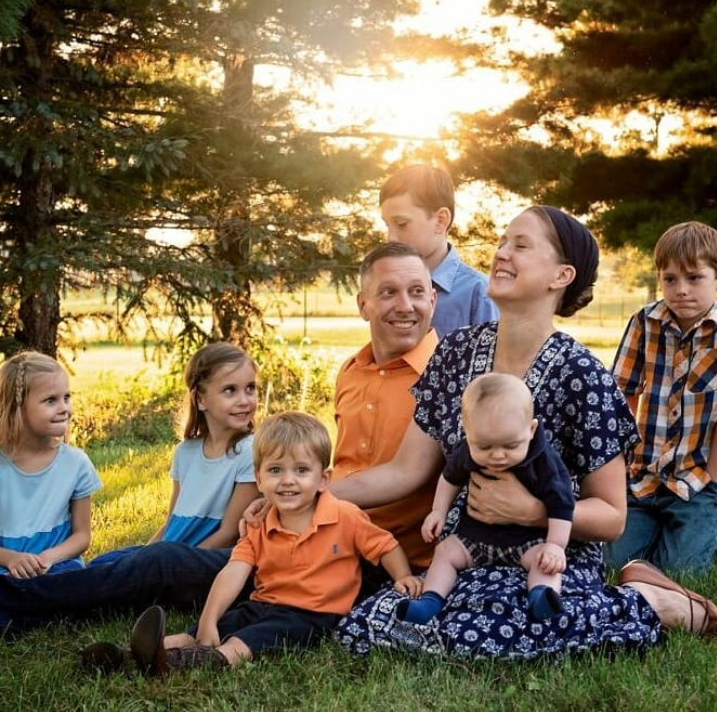
Today’s homeschool chat brings you the lovely Jessica , a homeschool mom of 6 , who resides in the USA together with her husband, Adam. She can be found on Instagram (@threerivershomestead), where she shares snippets of not only their homeschooling journey, but also anything related with homesteading and farming .
Tell us a bit about your family and your child/children.
My name is Jessica and I have been married to my husband, Adam, for nearly 13 years. We have six children between the ages of 12-1 and home school them on our tiny homestead in northwestern Ohio.
2. What was your main reason for choosing to home educate your children?
The main reason we initially decided to homeschool our oldest son was because of his anaphylactic allergies to peanuts and dairy. We didn’t feel comfortable sending him off to eat in a cafeteria where he could potentially be exposed to life-threatening allergens. We made this decision when he was a toddler and as we started looking into homeschooling more, and continued having more children, we learned that it was a great way to educate our children, food allergies or not. As we grew into the parents we were called to be, we realized that home education was right for our family.
3. What does a “typical” homeschool day look like for you and your family?
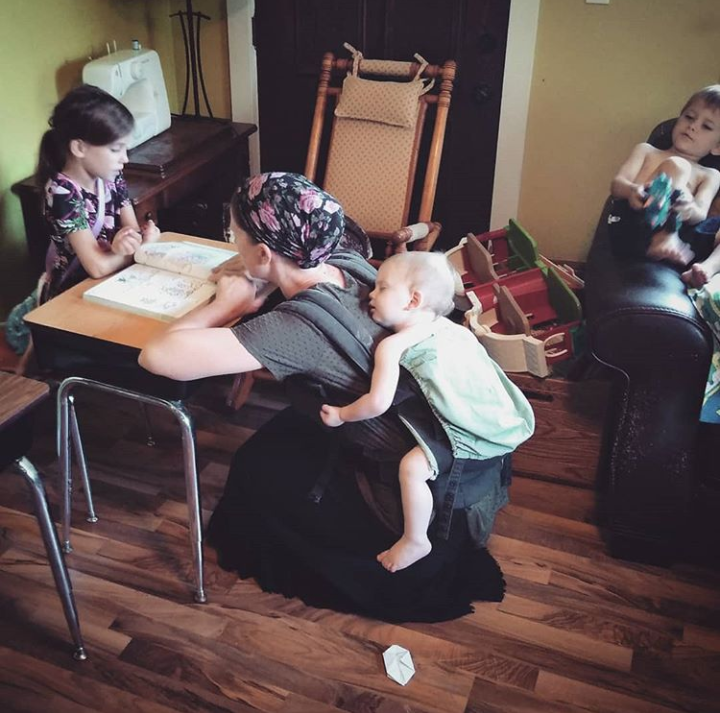
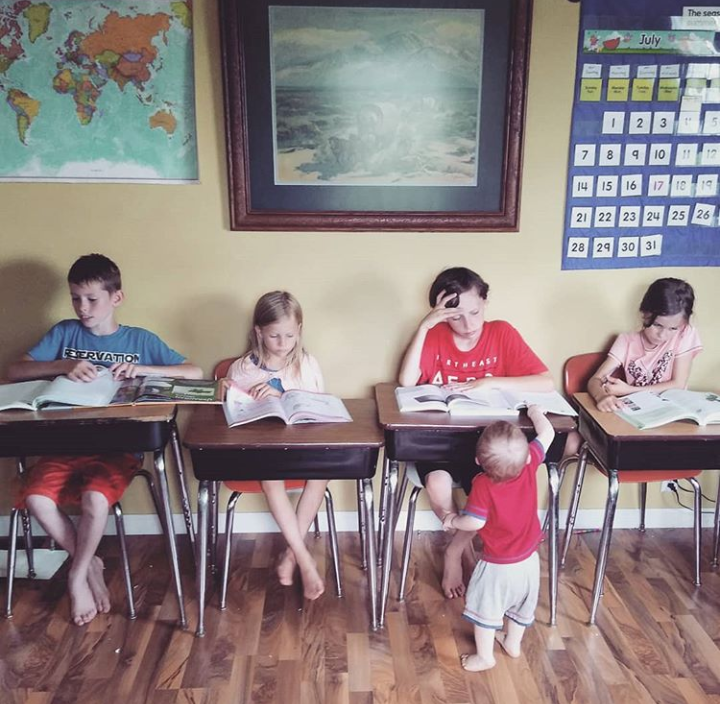
A typical day for us begins at 7:00 am. My older children do their farm chores and then we eat breakfast. Immediately after breakfast we do our morning house chores and everyone gets ready for the day. Then school begins with Bible read-aloud time, followed by about two hours of our book work. Each of my four older children get thirty minutes of individual instruction, one hour of independent study, and thirty minutes of entertaining their younger siblings during that two hour block. After we finish we eat lunch and then use the remainder of our day for homestead projects, playtime, and other fun child-led learning activities.
4. What type pf a home educator are you (structured,semi structured, unschooling, classical, Mason, Steiner , Montessori etc ) ?
I would classify our family as structured unschoolers. We only use curricula for the three R’s and let the children decide what they want to study for all other subjects. Living on a small farm provides many opportunities for nature study, which is a big part of our homeschool. We also enjoy family read-alouds to fill in any gaps.
5.What do you love the most about homeschooling?
What I love most about homeschooling is the way it unites our family. Other educational options can run the risk of fracturing the family unit, but home education seems to deepen both the parent-child bond and sibling bonds. Creating an environment , where my children feel like an essential part of the family unit and where we are working and making memories together builds character and a bond that will benefit them in so many ways as they grow. These are things the public school system cannot replicate.
6. What is your favourite subject to teach and what is your least one?
My favorite subject to teach is Maths. It’s a subject with clear rules and structure, which is really easy for me to explain. I have struggled the most with teaching writing, probably because the subject is much less objective.
7.What do you find challenging when it comes to homeschooling your children?
The biggest challenge of homeschooling seems to change for me in different seasons of life. Currently, I have four school-age children between the ages of 6-12, plus two very active little boys, ages 1 and 3. Keeping the little ones entertained and quiet while I try to work with the big kids is a daily struggle. Doing our read-alouds can be very frustrating with loud toddler distractions, so I often resort to audio books that allow me to deal with the problem while someone else reads.
8. How do you deal with unsupportive family, relatives and friends?
When I began homeschooling I received so much criticism from people. I spent years taking the bait and engaging in exhausting debates about socialization and statistics on educational outcomes. Then something switched probably 3-4 years in. My own process of “deschooling” , mixed with finally seeing the fruit of my labor in my children , created confidence in our decision. With my insecurities gone, I didn’t feel the need to try to change anyone’s opinion on the topic. I know what we are doing is what is best for our family and people can choose to disagree or not. It doesn’t change the amazing results I see in my children, which don’t require anyone else’s stamp of approval.
9. Where do you see your homeschooling journey in five years’ time ?
In five years , my oldest will likely be nearing graduation and my youngest will be in Kindergarten. It’s hard to think that far ahead when life as a homeschool mom has me often taking things one year, season, or even day at a time. I imagine having very independent and capable children in the future, who, Lord willing, are passionate about what they choose to study and want to make the world a better place. If my kids are obedient to God’s calling in their life, that is what matters, whether that path takes them to post-secondary education options or not.
10. What advice would you give to anyone who wants to start home educating their children ?
My advice to anyone starting is to let your first year be a trial run. Don’t try to put yourself in a box or mirror what you see working for someone else. We chose this for our children because we recognize their individuality. Remember that our families function uniquely as well. Figuring out what works takes time and will likely change frequently, especially in the early years or if you have other small children and/or pregnancies to deal with. Don’t feel like you’re failing if you have to change things up mid-year. You will likely be changing things up quite often for the rest of your homeschool mom “career”, and that flexibility is the beauty and blessing of this lifestyle. Pray about it and listen to the needs of your family, as well as the input of your children. That is all that matters!
I was recently sent ” The Six Cards – How to teach your child Qur’an ” by Amina Mohamed and although I reviewed this book on my own Instagram account, I find it is always better to write a blog post , as it can be much more detailed.
The book is written by fellow homeschooling mother of 4, Amina Mohamed. She holds a degree in Digital Media and a Masters in education. Here is Amina’s story and why she wrote this book : “For many years I have worked teaching children both in religious and secular establishments. For quite some time I also spent many hours teaching privately in homes. What I found is that the whole concept of learning takes a lot of energy in order to attain the knowledge or skills presented. This is more difficult when it comes to language. However, our mosques and teachers would teach the basic Arabic language to our youngsters in a very monotone, style. It was no wonder children would despise the whole Arabic learning experience and would always say it was difficult and boring. This is how The Six Cards; How to teach your child Quran came about. ”
The ultimate aim of the book is to help parents have the necessary tools in order to equip their children with how to read the Quran. As Amina writes : ” This is what is meant by laying the foundations. The foundations that every child needs is Islam , and Islam begins with Quran. ” I could not agree more with these words.
I honestly wish I had this book, when my eldest was starting her Qur’an journey when she was 6. It would have saved us a lot of time and also money on resources and products , which we never ended up using. I really love that the book is simple , short and easy to use and Amina is very clear and precise with what you have to do as a parent.
She covers so many aspects that are part of everyone’s Quran Journey- starting with The importance of tarbiyyah, reasons for teaching Quran and why it should be taught before any other studies. I also thoroughly enjoyed her chapter on how children learn and learning through play.
For anyone, who also uses tutors for teaching your children Qur’an, Amena also gives lots of tips on what qualities to look for in a tutor.I also absolutely loved her chapter “Elements required for success to occur”, placing a big emphasis on Du’a, which for sure is our most powerful tool. As Amena writes ” Pour your heart to Allah. Ask Him for whatever you desire for your children-whether it may be success, good manners, etiquette and achievement. Whatever it may be, ask Allah. Do not hold back as nothing is too small or too big for ALLAH to not give you. ”
Amina has also included a short educational plan looking at the various stages of a child’s development (0-2;3-6 and 6 and above ) and what your child can learn at the particular stage.
The book also comes with the six cards , which is all you will need to begin the next step after learning the Arabic alphabet. ” Each card has a designated vowel ( Fatha, Kasra , Damma and the Tanween ). Amena gives detailed explanation on how to use the cards and also what Qa’idah book to purchase once you finish the cards with your child. I really loved her tips on what Qa’idah to use too. There are so many Qa’idahs available these days and it can be really hard to choose ( needless to say overwhelming too ) which one to purchase.
Overall, the book is full of practical advice and lots of helpful tips. It is simple, concise and clear and it will truly give you a stepping stone into how to start your child’s Qur’an journey. I also really loved the inspirational quotes used throughout the book too. “The Six Cards- How to Teach Your Child Qur’an can be bought from https://knowledgefountainbooks.com/shop/
” The children should have the joy of living in far off lands, in other persons, in other times-a delightful, double existence; and this joy they will find, for the most part, in their story-books. ” Charlotte Mason
Today’s homeschool chat brings you Umm Affan , who is an Australian homeschooling mother of 2 . She is also a blogger and author of the ” I love Muhammad (SAW) Board book. Umm Affan can be found on Instagram https://www.instagram.com/the_odd_muslimah/ and you can also visit her website https://www.theoddmuslimah.com/.
1. Tell us a bit about your family and your child/ children:
Assalamu Alaikum ! I am Umm Affan. I am a dentist by qualification but a full time mommy by choice.We are a family of 4 Alhamdulillah. The eldest is a boy who is five and a half years old and the girl is two and a half. It’s our first year of “officially” homeschooling our boy even tough I feel I have been doing it all this time.
2. What was your main reason for choosing to home educate your children ?
Being a dentist (and an ambitious one) I never thought I would be homeschooling my children. Like everyone else I had these common assumptions about homeschooling. But it’s amusing how after actually having children you re assess many of your notions. Homeschooling for me is basically extension of my belief in philosophy of gentle parenting and tarbiyyah. Apart from that, my reasoning for homeschooling also comes from my own experiences from being “schooled”. I had been bullied on several occasions. The trauma of those experiences travelled with me into adulthood , making me lose confidence and making it hard for me to connect socially and make friends. I believe nobody should have to experience such experiences from their peers (or even teachers) at such a tender age. I want my children to be confident in themselves before they venture out in the world and nobody can give those solid foundations better than parents themselves.
3. What does a “typical” home school day look like for your family ?
Okay so let me tell you about the “ideal” day when we are home and not anywhere to go because our typical days are all over the place :D.
I get up at Fajr before the children are up. Get a little cleaning done before they are up. Play the Quran which usually wakes the children up. When children are up they have honey and water the first thing. They munch on nuts or just finish their honey water while I prepare their breakfast. After having our breakfast, they see off their father to is work and say a little dua for him. Then afterwards ,we say our morning adkar together while we all finish our breakfast. Our lessons usually start with reading and revising the Noorani Qaida. We recite and revise the Surahs. We read a lot of books with some pencil work here and there. Then they do some free play while I do some cleaning. At around 11 am we go for a stroll or drive to some park. The children will have lunch at park or when we come back at around 12:30 pm. Afterwards they either have a nap or free play wit their toys or just in the backyard. After their father gets back home, we pray maghrib together, have our dinner. Then their father takes them to change for the night, read them books while I do clean up and get the house straight for the next day.
4. What type of a home educator are you ( structured , semi structured , unschooling , classical , Charlotte Mason , Steiner , Montessori etc )
I am go with the flow kind of homeschooler ,which means I have tried pretty much everything but for now my heart has come to be settled at unschooling. But as the children grow, we might move to other “styles”. For now “unschooling” is working for us considering the point of life we are at Alamdulillah.
5. What do you love the most about home schooling ?
The flexibility! And also no school runs because Allah knows I wouldn’t have been able to take that stress! Huge respect for those mamas.
6. What is your favourite subject to teach and what is your least one ?
I just love retelling my children stories from the Quran and science! My least would be maths!
7. What do you find challenging when it comes to home schooling your children?
Carving out that “me time” for myself. I try to get up before everyone does so I take the time to do things I like doing. But some days its not possible. I try that children see me doing things I love so they know mom is a real human with wants and needs, likes and dislikes. But you know how it gets with having children around you all the time and when they are still very little.
8. How do you deal with unsupportive family , relatives and friends ?
Homeschooling is very important to us as a family at least at this point in life. So if no one is willing to understand that, I just don’t engage with them.
9. Where do you see your home schooling journey in 5 years’ time ?
Honestly I don’t know because at the moment we are just taking it by year. I would like to homeschool my children as long as practically possible. But I am also very flexible to the fact if our circumstances change and I am unable to handle it, then they might have to go to school.
10. What advice would you give to anyone who wants to start home educating their children ?
To be very clear about your “why”. Make a mission statement, save it in your folder or stick it somewhere where you can get back to it when you feel you are stuck in a rut or just overwhelmed by all the demands. Because to be honest if you aren’t very clear on your motives, it’s very easy to get sidetracked and lose your own voice in your head as to why you wanted to do it in the first place.





 Let's learn , Mama!